Why Damp Meter Calibration Matters and Why Most Surveyors Aren’t Doing It
A Professional Standard That’s Often Overlooked
When did you last calibrate your damp meter?
For many surveyors, the honest answer is: not recently — or not at all. It’s not due to negligence. It’s simply because the meter switched on, it beeped, and the inspection moved forward.
However, under RICS professional standards, all equipment used during an inspection must be:
Fit for purpose
Properly maintained
Supported by documented evidence of calibration
A damp meter is no exception.
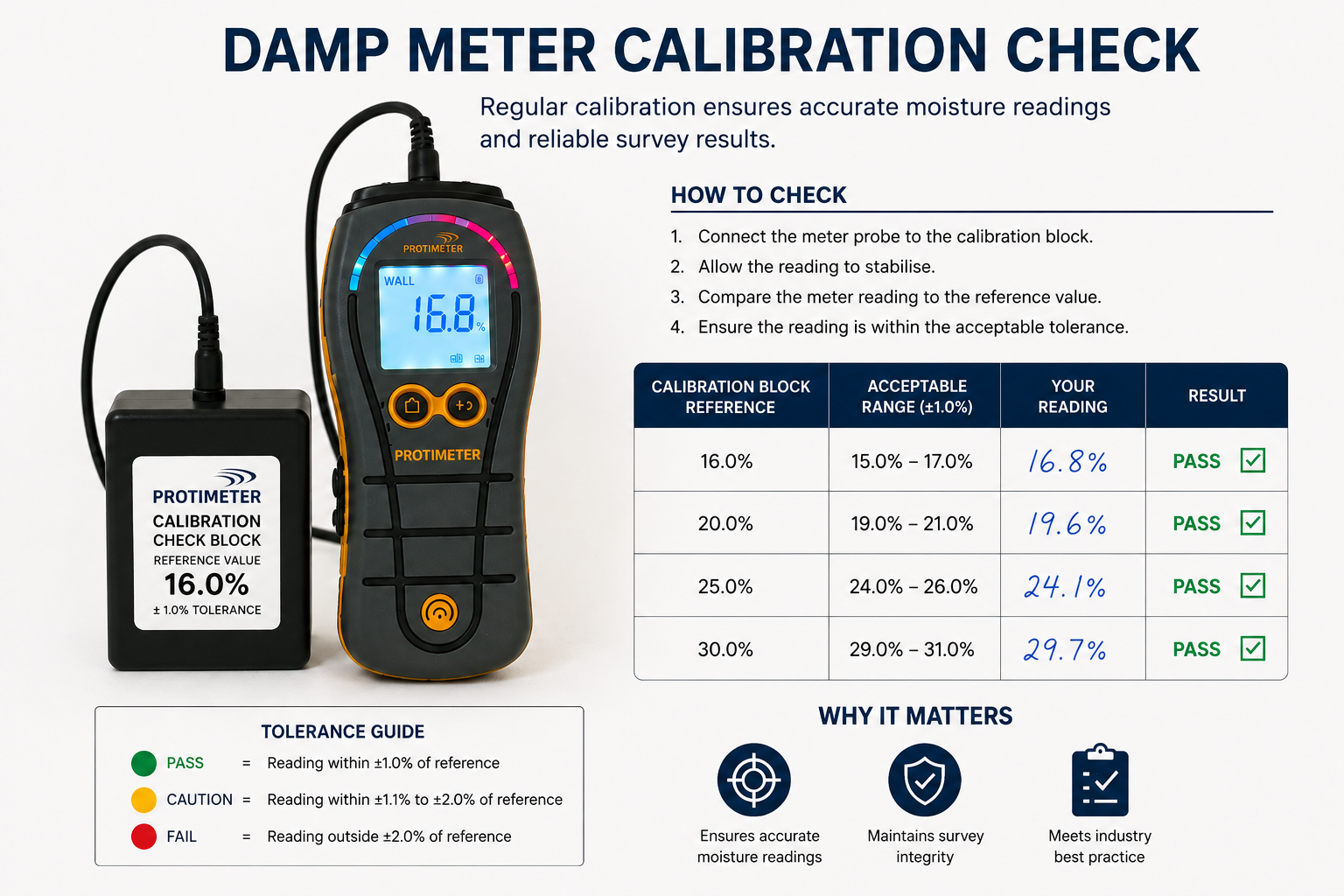
What Calibration Actually Means
Calibration is a straightforward process. It involves checking your damp meter against a known reference value using a calibration check block.
A compliant reading should fall within ±2% of the block’s rated value.
If it doesn’t, the instrument must be serviced or replaced before it is used again.
The entire process takes approximately five minutes, and for most surveyors, performing this check quarterly is sufficient.
The Equipment You Need
Surveyors using Protimeter devices — the most common in residential surveying — require the:
Protimeter Calcheck (BLD5086)
Key points:
It is supplied as standard with all pin‑type Protimeters.
Because it is small, it is frequently misplaced or damaged.
Many surveyors already own one without realising it.
If a replacement is needed, they are widely available:
Amazon UK — approx. £18.95 inc VAT
Trade Survey/specialist suppliers — from £12 inc VAT
How to Perform the Check
Touch the meter pins to the Calcheck contact points.
Observe the reading.
It should display 18% ±1%.
If the reading falls outside this range, the meter requires attention.
Why Calibration Is Critical
Calibration is not an administrative exercise — it is a risk management requirement.
When damp‑related findings are challenged, whether through:
A customer complaint
A professional indemnity claim
A legal dispute
…the first questions an expert witness will ask are:
Was the instrument calibrated?
Is there a calibration record?
Without a calibration log, every damp reading you have ever reported becomes open to challenge — not just the reading in dispute.
This is not theoretical. It is a genuine liability exposure for surveyors and firms.
Professional Credibility Depends on It
Surveyors accept calibration as standard for:
Gas analysers
Electrical testing equipment
Structural monitoring devices
A damp meter is no different. If it forms part of your diagnostic process, its accuracy must be verifiable.
A damp meter is only as reliable as its most recent documented calibration check.
A Question for the Profession
Do you have a documented equipment calibration log?
No judgment — the honest answer across the industry is usually “no.” And that’s exactly why we need to talk about it more openly.
If we want to raise standards, reduce disputes, and protect ourselves professionally, calibration needs to become part of routine practice — not an afterthought.
Drop a comment. Let’s have the conversation.